
Cyber Heist
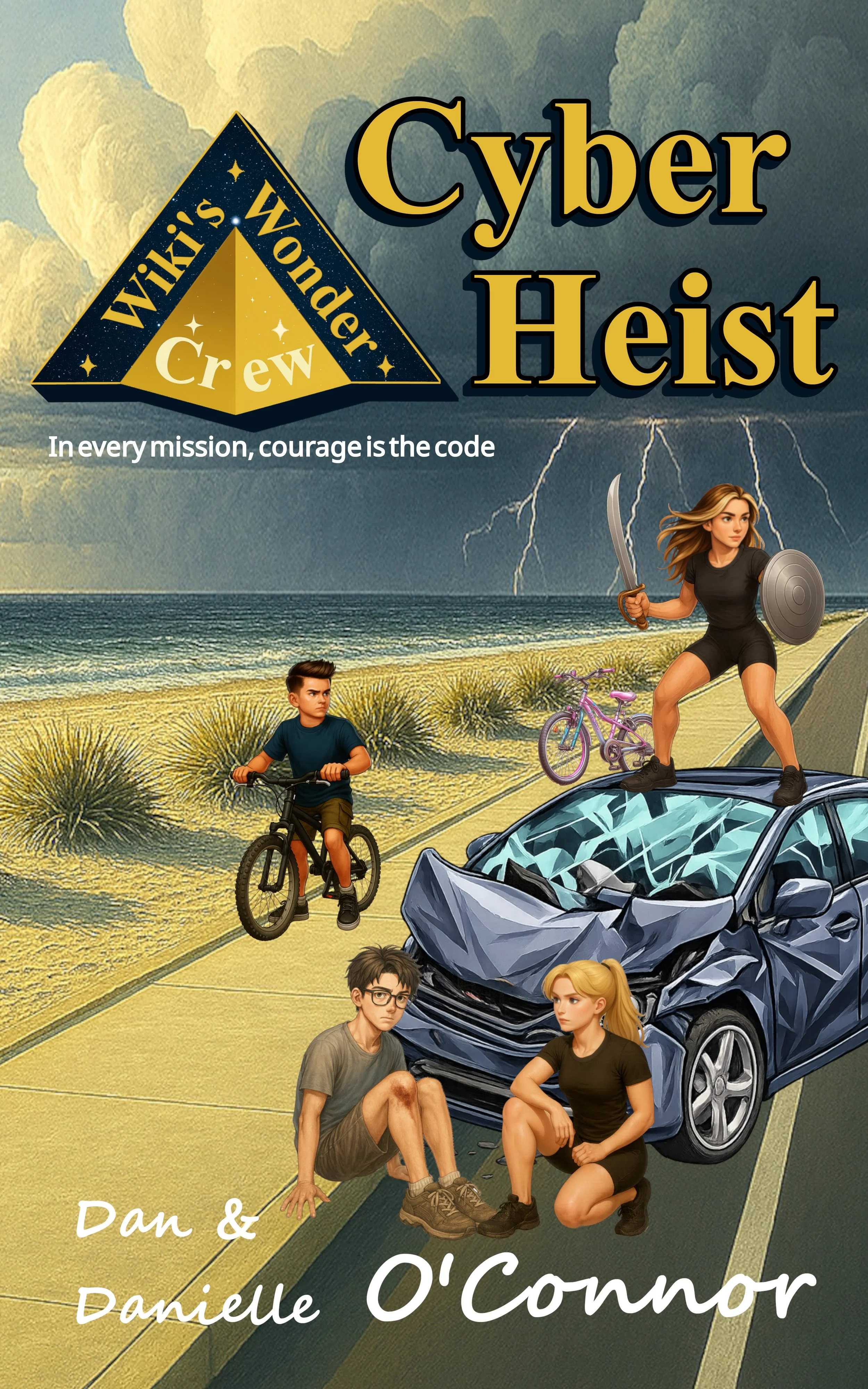
Cyber Heist is the debut novel of the Wiki’s Wonder Crew series written by Dan & Danielle O’Connor.
One cybercriminal gang...
One ruthless mastermind...
One invincible AI gone rogue ...
Thirteen-year-old tech prodigy Wiki Jones never meant to help the notorious cyber-gang known as the Blackout. But when they target him for the knowledge that enables them to steal CLARA—his dad’s groundbreaking AI—the Blackout unleash DARK, a rogue hacker with a mind of his own.
Now, Wiki and his crew—athletic Kayla, stylish Olivia, and impulsive Matthew—race to stop the Blackout before their city is lost to chaos. As secrets unravel and danger closes in, they must rely on courage, code, and cunning to crack the mystery.
With the fate of CLARA, their city, and their loved ones on the line, Wiki’s Wonder Crew must pull off the ultimate heist—before the blackout becomes permanent.
—————————————————————-
Fast-paced, funny, and full of heart, Cyber Heist is a thrilling mystery adventure about friendship, redemption, and the power of doing the impossible—together.
The countdown has begun. Are you ready to join the crew?
The first review is in…
We’re thrilled with the Kirkus review. Here are a few excerpts from the review.
“An entertaining introduction to some gifted adolescent heroes who will easily win fans.”
“A lively cast headlines the O’Connors’ debut novel… it's a treat to follow these youthful characters as they use their wits and tenacity to take down the Blackout... The ending makes it apparent which direction the next entry will likely take, and readers will surely yearn for more of Wiki, Kayla, Olivia, and Matthew.”
"Younger readers will have no trouble understanding the relatively simple technology (such as a few details on hacking). The story offers educational value."
— Kirkus Reviews
Why we wrote this book
This book was inspired by our previous manuscript that we wrote but did not publish yet about Wiki’s Wonder Crew. That manuscript is called The Case of the Gold Cup Culprit which is the first book in our Wiki’s Wonder Crew - Voyage Academy series. When Danielle’s friends read it, they were so intrigued by a brief backstory of how the Wonder Crew got their name that they wanted to hear more. The result was Cyber Heist. It made sense to write Cyber Heist as the true original book. For a long time, we called Cyber Heist book zero since the Gold Cup Culprit was book one in our eyes. We debated naming the book The Day of Reckoning since the countdown to that day plays such a large part in the story. Ultimately, we settled on Cyber Heist since it has multiple meanings.
For a more in depth view on how it started, see our How It Started Page
Can you imagine someone giving you a two-paragraph backstory and saying, “Now create a book about that.” That is precisely what Danielle and Dan did to ourselves.
Q&A with the Authors
Question 1. Is this a mystery or a thriller?
Answer: Cyber Heist is both a mystery and a thriller.
The thriller side is easy to spot: a criminal gang seizes control of the most powerful AI ever created, and the stakes escalate fast. We show the danger without drifting into horror, keeping the focus on suspense, action, and cheering for our heroes as they race to stop the Blackout.
At the same time, the story is built like a mystery. You follow two parallel paths—the villains pursuing their plan and the Wonder Crew uncovering clues, connecting dots, and trying to figure out who’s behind the attack. Seeing both sides doesn’t remove the mystery; it heightens the tension because you know what’s coming before the characters do.
The fun is in watching how the Wonder Crew pieces everything together. My hope is that readers solve it just in time—and maybe even go back for a second read to catch the clues they missed the first time.
Question 2. Is this book just for kids?
Answer: Cyber Heist is written with a younger audience in mind, but we’ve always believed it’s a story anyone can enjoy. Danielle layered in humor and moments that resonate with middle‑grade readers, while Dan added jokes and character beats that parents and older readers will catch—like the intern working for an evil cyber‑crime organization or Pyrite’s inner commentary whenever Sphinx starts talking.
The book has plenty of playful touches for all ages, including the villains’ code names—Sphinx, Pyrite, Pup‑Pup, and Osiris—which readers young and old tend to love. At its core, it’s an adventure meant to be shared, whether you’re a kid, a parent, or simply someone who enjoys a fun, fast‑paced story.
Question 3. Why did you write this book?
Answer: Cyber Heist actually grew out of another manuscript we wrote first—The Case of the Gold Cup Culprit, the opening book in our Wiki’s Wonder Crew: Voyage Academy series. In that story, we included a short backstory explaining how the Wonder Crew got their name. When Danielle’s friends read it, they immediately wanted to know more. Their reaction made us realize that the “origin story” deserved its own book.
That’s how Cyber Heist was born. For a long time, we jokingly called it “Book Zero,” because in our minds Gold Cup Culprit was Book One. We even debated naming it The Day of Reckoning, since the countdown plays such a big role, but ultimately Cyber Heist fit best—it carries multiple meanings that tie directly into the plot.
If you want the full behind‑the‑scenes version, you can check out our How It Started page. But the short version is this: we gave ourselves a two‑paragraph backstory and said, “Okay… now turn this into a whole book.” And that challenge became one of the most fun creative adventures we’ve had.
Question 4. How much of the technology in the book is real?
Answer: The technology in Cyber Heist is inspired by real concepts, but it’s intentionally simplified so younger readers can follow the action without needing a computer science degree. The AI, the hacking methods, and the cyber‑crime tactics are rooted in real ideas, but we dialed everything up to make the story exciting, fast‑paced, and accessible.
Our goal wasn’t to teach readers how to hack—it was to spark curiosity about how technology works and how it can be used responsibly. We wanted the Wonder Crew to feel clever and capable without turning the book into a technical manual. So while the story is grounded in reality, the details are shaped to serve the adventure, the humor, and the characters.
Question 5. Are you worried that you could have inspired a real criminal with ideas from the book?
Answer: Not really. The scenarios in Cyber Heist are fictional and intentionally simplified so younger readers can follow the action without getting a crash course in real‑world hacking. Anyone with serious criminal intent already knows far more than what’s in a middle‑grade adventure novel.
If anything, I hope the book inspires the opposite—curiosity, creativity, and maybe even an interest in using technology for good. And if a real hacker happens to read it, maybe they’ll root for the Wonder Crew and rethink their career choices.
Question 6. Why did you choose the villains’ code names (Sphinx, Pyrite, Pup‑Pup, Osiris)?
Answer: We wanted the leaders of the villain group to feel larger‑than‑life, so we rooted their code names in Egyptian mythology. Names like Sphinx and Osiris instantly give the sense of something ancient, powerful, and mysterious—perfect for the bosses of a cyber‑crime organization.
Pyrite and Pup‑Pup came from a different angle. Pyrite is a mineral often called Fool’s Gold, which felt like the perfect nickname for a villain who the bad guy leaders don’t know what she’s worth. (Fun fact: Dan once nicknamed a function “Pyrite” for the same reason—the customer expected to answer bigger questions than the oversimplified thing they asked for.)
And then there’s Pup‑Pup. Giving an intern in an evil organization an adorable, almost cartoonishly cute name was too good to pass up. The contrast is the joke: a bad guy with a name that sounds like he should be chasing tennis balls instead of helping run a cyber‑crime ring.
Question 7. Who is your favorite character to write, and why?
Answer:
Dan: I love writing from Wiki’s perspective. I see a little of both Danielle and myself in him—though probably a bit more of Danielle. She has a heart of gold, tends to internalize things even when they aren’t her fault, and always wants to do the right thing. Wiki’s journey mirrors her own path of learning to trust her instincts and lean on the people who truly care about her.
Danielle: That is the cheesiest thing ever, Dad. My favorite is Kayla. She’s quick with a comeback, she’s brave, and she leads with her heart. She’s the kind of person I hope to grow into—funny, confident, and unafraid to speak up.
Question 8. How did you and Danielle divide the writing responsibilities?
Answer: After outlining the story at a high level, we wrote the chapters together using Google Docs on separate devices. One of the best things about Google Docs is that you can write in the same document at the same time and watch the other person’s ideas appear instantly. We’d take our bullet‑point outline and expand it into full scenes—sentences, paragraphs, and dialogue.
When a conversation unfolded between characters, we often split the roles: Danielle would write one character’s lines while Dan wrote the other’s. It made the dialogue feel natural and kept the energy high. We’ve tried to leave you wanting just one more chapter. Once the full draft was complete, Dan handled the editing phase, shaping everything into a smooth, cohesive final version.
Question 9. What do you hope young readers take away from the story?
Answer: At its core, Cyber Heist is about courage, friendship, and trusting your instincts. We hope young readers walk away feeling empowered—knowing that even when the world feels overwhelming, they can rely on their values, their creativity, and the people who truly care about them.
We also want readers to see that being “smart” isn’t just about knowing facts. It’s about asking good questions, working as a team, and staying curious. The Wonder Crew succeeds not because they’re perfect, but because they support each other, learn from their mistakes, and keep going even when things get tough.
And finally, we hope the story sparks an interest in technology—not fear of it. Tech can be used for good, for problem‑solving, and for helping others. If a reader finishes the book thinking, “I want to build something cool someday,” then we’ve done our job.
Question 10. Are you working on other books in the same universe?
Answer: Absolutely. As we’ve mentioned, Cyber Heist was actually the second book we wrote, even though we jokingly called it “Book Zero” because The Case of the Gold Cup Culprit was originally planned as Book One. With everything we learned while writing Cyber Heist, we’re going back to revise and strengthen Gold Cup Mystery before releasing it.
And there’s more on the horizon. My eight‑year‑old son Matthew has declared Cyber Heist his favorite book and has already asked to write one with me someday. So who knows—there may be a future Wonder Crew adventure with a father‑son twist waiting to be written.
Question 11. How did you use AI?
We wrote this book in its entirety. However we did use AI in two unique ways…
Creation of primitive picture objects.
Research into various topics - e.g. supplementing google search that would direct you to Wikipedia with a summary of what AI knows.
Do we think it’s ironic that we used AI to help us in a book about AI? Answer: Yes
Base Picture Creation
Dan spent almost as much time on the pictures as we did writing the original text. He used AI (Microsoft Copilot) to create many of the picture primitives (e.g. a character standing a certain way).
Picture Creation Process
Brainstorm what we want to show in the picture based on text in the book
Open your picture editing tool. We used GIMP - GNU Image Manipulation Program. GIMP is an open-source tool for image manipulation program. Think a free version of Adobe InDesign. Gimp allows you to have Layers and manipulate every aspect of a picture or even draw something new.
The basic AI picture creation process is:
Ask Microsoft Copilot to draw something.
Review what Copilot gave you. Save it (because you save everything. You never know what you might Frankenstein together)
Ask Copilot to make some change to a feature you didn’t like. Sometimes it gives a totally different picture. Sometimes it latches onto the wrong thing. Sometimes it continues to give the same picture in the wrong way. Once it goes wrong, or if you want something completely different, then start a new conversation and feel free to give it the same prompt or a similar prompt. If you did a lot of back and forth with copilot, it is sometimes good to ask copilot to give you a description of what you asked it to draw so you can give that same description the next time
Tips:
When asking to create characters. Ask to draw them on a transparent background. This will make life easier when you are merging everything together.
Sometimes if you have gone back and forth with copilot refining a character, you may have to tell it to put on a transparent background again because it imagines transparency but really puts it on a checkerboard.
You can paste in a picture of some character and ask it to show the character in some different pose. Unfortunately, sometimes it changes details about the character such that they don’t even look like the same character. If they gave you a good pose but the wrong face, I’ll use GIMP to cut the head off the new picture and bring in a previous iteration (remember I said save everything).
Microsoft Copilot likes to make outsized heads on their clip characters. I like more real so I found myself always copying and pasting their heads (in GIMP) and using the scale layer to bring the head in better proportion. then erase the head and you can merge down the layers to get the new character.
If copilot is having trouble the entire scene to your liking. take parts out and have them drawn separately. Then combine them in GIMP
Save early, save often. GIMP does crash and you could lose all your work.
4. For the rest of the steps, we will assume you did the basic AI picture creation process.
Ask Copilot to draw the base scene
Example: Please draw me a picture for my book that I'm writing. I would like a clipart picture of a view of an internal warehouse that is fancy'd up to be more like that of a night club. The inside of the warehouse had an open layout reaching from ground level to the roof thirty feet above. speakers mounted throughout the space. There is a catwalk that goes around the warehouse at the second level. . Down on the first level was what looked like a fancy computer lab with eight-foot-tall server racks with a mix of red and green blinking lights. There were about eight empty computer stations with each station holding four large screen monitors and keyboards that had aqua blue backlights. There is a table in the center. Each computer station had an advanced gaming chair. Around the edges of the room were cots for the regular workers to sleep at. a twenty foot by forty-foot shipping container at the back of the warehouse. The container was painted black. The end of the container has a jail cell door. Mounted above the server racks on the far side of the room was a large neon green sign that read “Welcome to the Blackout’s Duat. Our Underworld is Your Underworld.”
Import the base scene into GIMP
Ask Copilot to draw a character. Manipulate the character as needed in GIMP. Paste the character into the base scene and adjust the scale based on where they are in the base scene. The closer to the user, the bigger.
Example: Can you take this character and change her to be standing up looking to the right. put her in a more stylish outfit. give her a light blue blouse and skirt above her knees. Make her hair down. she's got her arms down and is observing something with a little surprise. Keep the same hair color. She has a necklace and matching earrings. keep her on a transparent background
Continue to add things until you are happy
Export the picture to a png.
Research
We used AI (Microsoft Copilot) in researching a couple topics.
AI was instrumental in helping us determine how to hack a computer which is a vital part of the story. Although AI didn’t write the text, we queried it about the process of hacking a computer and what programs they might use.
AI helped us determine valuable Egyptian artifacts to use in our heist
Question: How real are some of the things in Cyber Heist?
Setting: Is Seaside real?
Answer: Seaside is a figment of our imagination. We put it in Florida because we love our Florida vacations but that is as close as we can get to reality.
Is Artificial General Intelligence (AGI) the holy grail of artificial intelligence. Is AGI out in the world now? If not, how close are we to it?
Answer according to Microsoft Copilot: AGI is widely considered the “holy grail” of artificial intelligence—but it hasn’t been achieved yet. While 2025 shows promising progress, experts agree we’re still years (or decades) away from true AGI. see AGI page for Copilot’s full answer
Could an AI be used to hack a system
Answer: That is beyond our knowledge but it will not surprise us if that happens in the near future. AI is currently being used to write programming code. It is not that big of a leap from writing code to writing code and then using it. Heck the AI, told us how to hack a computer.
Is the blackout a real Cybercrimal gang
Answer: Figment of our imagination
Characters: any resemblance to actual people?
Answer: All of the characters were brainstormed by Danielle and Dan. The characters and events portrayed in this book are fictitious. Any similarity to real persons, living or dead, is coincidental and not intended by the authors.
Artifacts: are any of those real?
Answer: The artifacts mentioned in this book are actually real. However, no one has actually put on an exhibit with everything in the same spot to our knowledge. For more information, see below:
Golden Mask of Psusennes I: According to Wikipedia (Psusennes I - Wikipedia), “Psusennes I's mask is considered to be "one of the masterpieces of the treasure[s] of Tanis" and is currently housed in Room 2 of the Cairo Museum.“
Copper Scroll: According to Wikipedia (Copper Scroll - Wikipedia), “The Copper Scroll (3Q15) is one of the Dead Sea Scrolls found in Cave 3 near Khirbet Qumran, but differs significantly from the others.” … “Unlike the others, it is not a literary work, but a list of 64 places where various items of gold and silver were buried or hidden.”
Dead Sea Scrolls: According to Wikipedia (Dead Sea Scrolls - Wikipedia), “The Dead Sea Scrolls, in the narrow sense identical with the Qumran Caves Scrolls, are a set of ancient Jewish manuscripts from the Second Temple period. They were discovered over a period of ten years, between 1946 and 1956, at the Qumran Caves near Ein Feshkha in the West Bank, on the northern shore of the Dead Sea.”
Rosetta Stone: According to Wikipedia (Rosetta Stone - Wikipedia), “The Rosetta Stone is a stele of granodiorite inscribed with three versions of a decree issued in 196 BC during the Ptolemaic dynasty of Egypt, on behalf of King Ptolemy V Epiphanes” … “The Rosetta Stone is 112.3 cm (3 ft 8 in) high at its highest point, 75.7 cm (2 ft 5.8 in) wide, and 28.4 cm (11 in) thick. It weighs approximately 760 kilograms (1,680 lb)”
Artifacts: Does the Copper Scroll really point to riches? More importantly, has anyone found them?
Answer: According to Wikipedia (Copper Scroll - Wikipedia), “Unlike the others, it is not a literary work, but a list of 64 places where various items of gold and silver were buried or hidden.” … “As a result, this evidence has led a number of people to believe that the treasure really does exist. One such person is John Allegro, who in 1962 led an expedition. By following some of the places listed in the scroll, the team excavated some potential burial places for the treasure. However, the treasure hunters turned up empty handed,[14] and any treasure is yet to be found.”