
Let Them Score: A Playbook Twist
🏈 Let Them Score: When Losing Is the Smartest Play
You might think “Let them score” is something a dominant coach says to throw the other team a bone. But if you know coaches—especially competitive ones—you know that’s not how they operate. Giving up points goes against their instincts, their egos, and often their ethics.
In fact, letting the other team score can be seen as bad sportsmanship. It might send the wrong message to your own players, and it’s not clear the other team benefits from a hollow victory. That said, every parent has let their kid score at some point—whether in driveway basketball or backyard soccer. But that’s not what we’re talking about here.
We’re talking about elite athletes in high-stakes competition. We’re talking about games where both teams are good, and the outcome hinges on razor-thin margins. Sometimes, the smartest move isn’t to stop the other team—but to let them score.
🕰️ The Penn State–Oregon Case Study
This exact scenario played out recently between Penn State and Oregon in football.
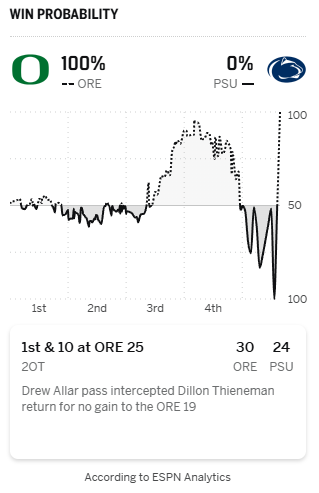
Penn State had the ball deep in Oregon territory with a chance to run out the clock and kick a game-winning field goal. Instead of playing conservatively, they scored a touchdown quickly—giving Oregon time to respond.
Oregon matched the score in the first overtime, then scored again on the first play of the second OT. Penn State’s quarterback Drew Allar threw an interception on their next possession, sealing the 30–24 loss.
It was a textbook example of how scoring too soon can backfire.
🏆 A Personal Memory: When Letting Them Score Worked
That game reminded me of a moment that wasn’t on national TV, but it meant a lot to me.
A few years after I graduated high school, my alma mater had a special team. We weren’t usually a powerhouse, but that year, we had something. In the first round of the playoffs, we were down by seven with under two minutes to go. The other team had the ball. All they had to do was run out the clock.
Then our coach did something bold. He called a timeout, walked onto the field, and told the defense to let them score.
They did.
Our team got the ball back, scored quickly, recovered the onside kick, and scored again winning the game.
Our team eventually lost in the semifinals to the eventual state champs. It was a shootout between the two best teams in the state, both scoring over fifty points. The game came down to who had the ball last.
But none of that would’ve happened if our coach hadn’t made the gutsy call: let them score.
🧠 Strategy Over Ego
It’s counterintuitive. It feels wrong. But sometimes, the right answer isn’t to fight for every yard—it’s to think two steps ahead. It’s the queen sacrafice in chess.
Letting the other team score isn’t giving up. It’s betting on your offense, trusting your team, and playing the long game.
Turns out, sometimes the smartest play is the one that feels all wrong—until it wins you the game.
